Writing about futures
Through books, studies, journal articles, talks, podcasts, webinars, research papers, and more, I make Futures Literacy and the method of Futures Literacy Laboratories more visible.

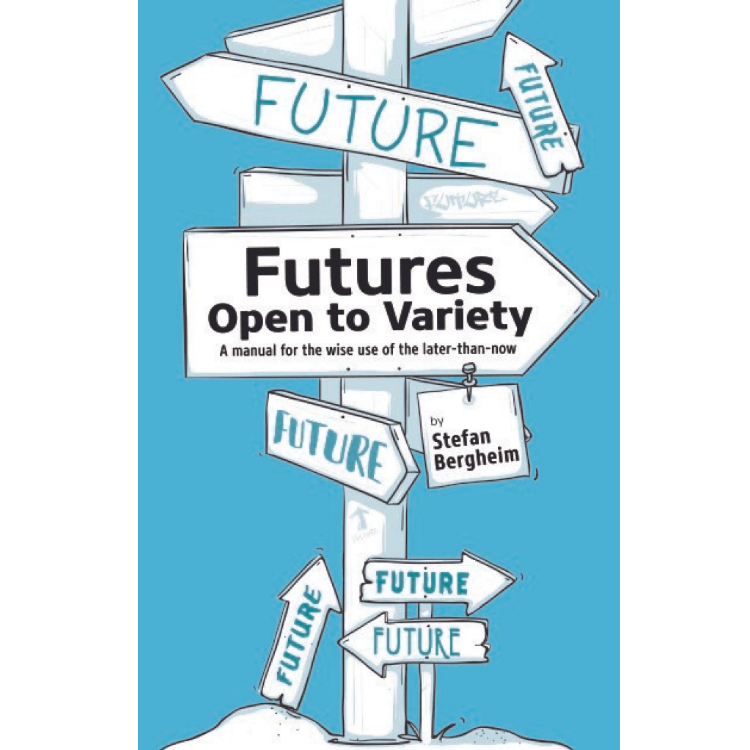
My 2021 book "Futures - Open to Variety” summarizes, in accessible language, what I have learned about dealing wisely with what may lie ahead. It is meant to make readers curious about doing their own futures work and offers many concrete suggestions for doing so. It includes a bit of theory, many methods, and concrete projects.
I am still excited about my contributions to Riel Miller’s book “Transforming the Future - Anticipation in the 21st Century,” published in 2018. I was able to act as a sparring partner for him on the first chapters, edit the case studies in chapter 4, and contribute a chapter of my own about our quality-of-life process in Frankfurt. In June 2018, I organized a book launch event in Berlin.
Ten years earlier, my dissertation “Long-Run Growth Forecasting” was published, incorporating many ideas from the project “Global Growth Centres 2020,” which I had the opportunity to lead at Deutsche Bank. In the dissertation, I used the statistical method of panel cointegration to extract as much information as possible about the future from time series on economic growth, physical capital, human capital, and openness.
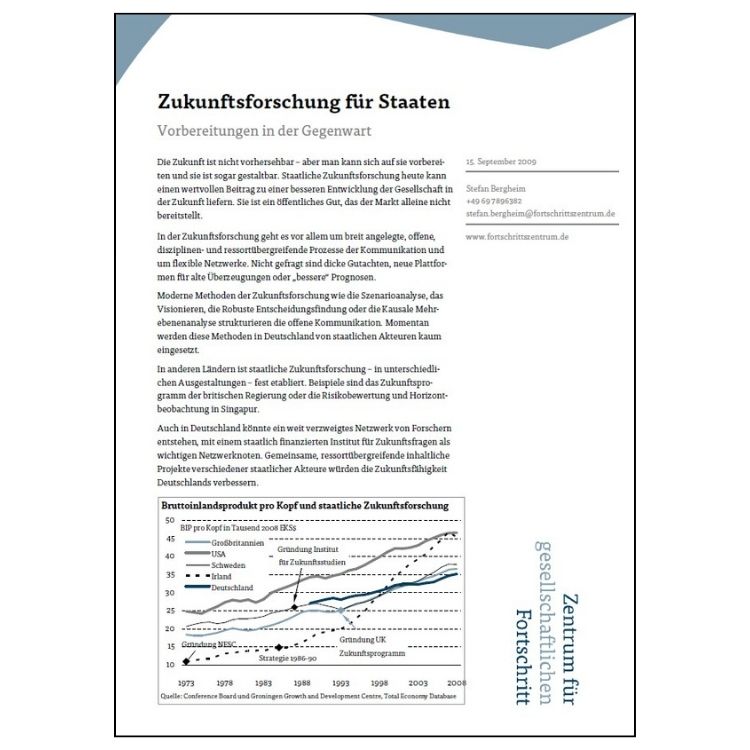
After leaving Deutsche Bank, I devoted myself more and more intensively to futures studies, still in the singular at the time. In "Zukunftsforschung für Staaten" (Futures Studies for States) of 2009, I emphasized the value of broad-based, open processes of communication across disciplines and ministries, as well as flexible networks. The method of the Futures Literacy Laboratory was not yet invented then.
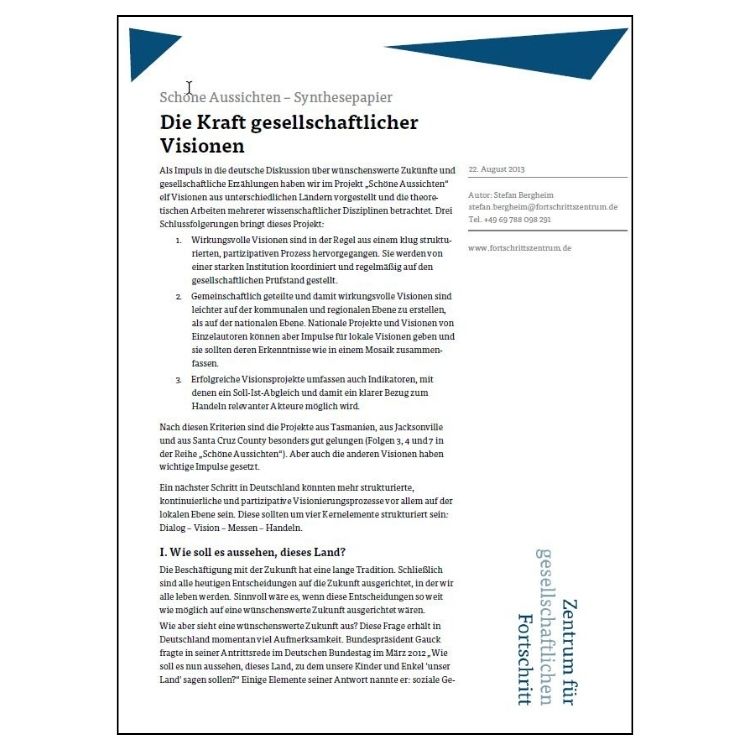
At the think tank “Center for Societal Progress,” founded in 2008, everything revolved initially around participatory visioning processes on the topic of quality of life. We analyzed processes in other countries and ran our own. In studies such as "Die Kraft gesellschaftlicher Visionen" (The Power of Societal Visions), we shared our findings.
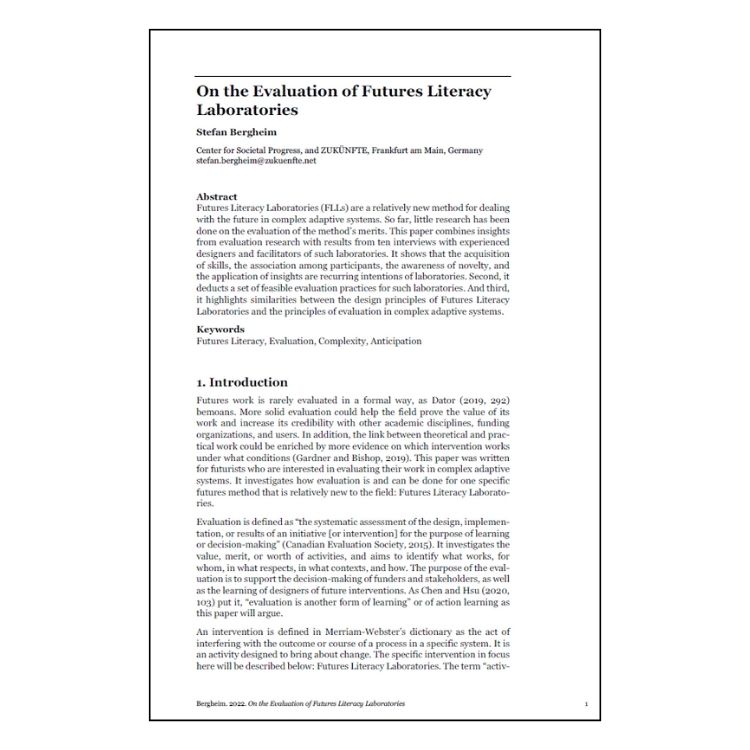
In 2022, I explored what Futures Literacy Laboratories can achieve and how the achievement of these intentions can be assessed. The study "On the Evaluation of Futures Literacy Laboratories" offers an initial overview. The Futures Expeditions with young people in 2023/24 were evaluated systematically on this basis.
The main object of investigation in Futures Literacy Laboratories are the assumptions that underpin our images of the future. They influence what we perceive in the present and how we act. In “Patterns of Anticipatory Assumptions” of 2023, I examine the patterns in 500 assumptions from our laboratories. There is a 13-minute AI podcast on this topic in English.
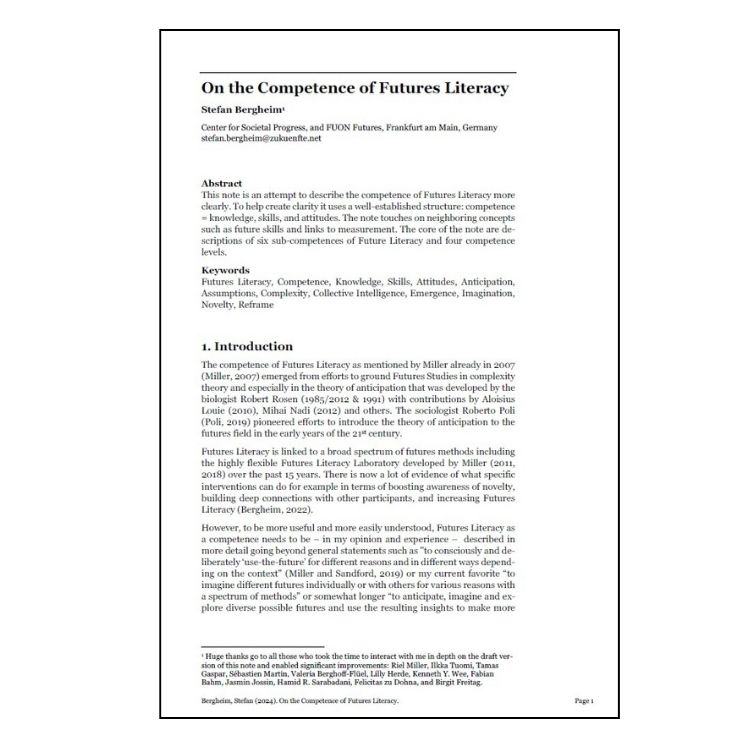
My latest study, “On the Competence of Futures Literacy”, provides a detailed description of futures literacy, comprising six sub-competencies and four levels of competence. Here is a 13-minute AI podcast on the subject in English.
Most of my writing and speaking about Futures Literacy is in German, but here are some videos and podcasts in English:
Together with Lena Tünkers, I spoke about alternative futures in a UNESCO webinar in 2022.
In 2023, I spoke with Peter Hayward in his FuturePod about the openness needed in futures work.